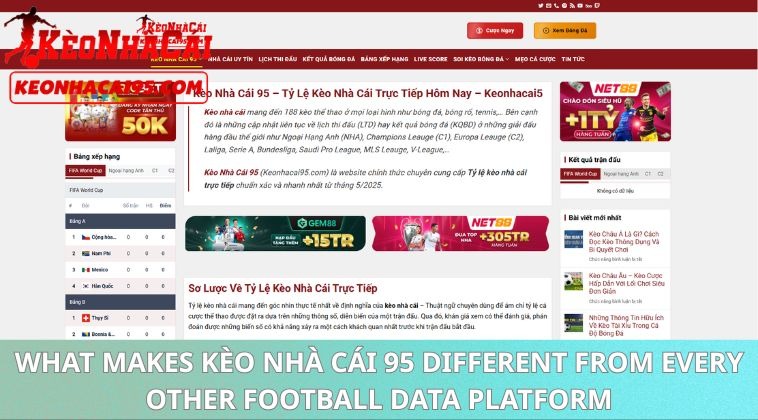
Picture this. You have done your research on a Saturday fixture, settled on a position, and are about to place your bet — then you find out the team’s key striker was ruled out at Thursday’s training session. The odds have already moved. The market adjusted hours ago. You are the last to know. This is the exact situation that Kèo Nhà Cái 95 is built to prevent. Keonhacai95.com runs as a continuously updated football data platform, feeding current match information — odds movements, team news, lineup updates, and statistical context — to users who want to make decisions based on what is happening now, not what was true yesterday.
The Problem With Static Football Data
Most football information on the internet has a freshness problem. Articles get written, published, and left to age. Odds get screenshotted and shared in group chats hours after the line has already shifted. Statistics tables update once per day, or once per week, or sometimes not at all until someone notices they are wrong.
For casual fans, this is fine. But if you are making betting decisions based on Kèo Nhà Cái data, static information is not just unhelpful — it is actively misleading. You think you have a current picture. You do not.
Continuously updated platforms solve this at the infrastructure level. Data pipelines refresh automatically, not on a manual publishing schedule. The result is that when you open a match page on a properly built platform, what you see reflects the actual current state of the market — not a snapshot from 18 hours ago.
What “Continuously Updated” Looks Like in Practice
This phrase gets used loosely. Let me be specific about what it actually means across the different data types that matter for football analysis.
Odds and Line Movement
Bookmaker lines move constantly in the 72 hours before a match. A handicap that opened at 0.5 on Tuesday might sit at 0.75 by Friday evening — reflecting injury news, sharp money positioning, or both. A platform that captures this movement in near real time gives you something genuinely useful: the ability to see not just where the line is, but how it got there and how quickly it moved.
That trajectory tells a story. A line that drifted slowly over 3 days suggests gradual public sentiment shifting. One that jumped half a ball in 4 hours suggests significant news hit the market. Knowing the difference changes how you interpret the current price.
Team News and Availability Updates
Club announcements, training ground reports, and pre-match press conferences all feed into match preparation. Managers drop hints about rotation. Physios confirm or deny injury concerns. Captains speak about squad morale after a difficult run. Most of this information surfaces across multiple channels at irregular intervals — which makes manual tracking impractical for anyone following more than 2 or 3 leagues simultaneously.
A data platform that monitors these sources and surfaces confirmed availability updates automatically saves hours of research time. More importantly, it ensures that a late-breaking injury report does not catch you off guard the way it catches bettors who rely on a single static preview article.
Live Match Statistics
In-play Kèo Nhà Cái markets move on the back of real-time match events. A goal, a red card, a goalkeeper substitution — each triggers immediate repricing. Platforms that surface live statistics alongside in-play odds give users the context to understand why lines are moving, rather than watching numbers change without explanation.
This matters more than it might initially seem. In-play betting without live data context is essentially guesswork. With it, you can assess whether a market movement reflects a genuinely significant event or a temporary overreaction that the line will correct within minutes.
Why Data Freshness Affects Betting Decisions More Than Most People Realize
Here is a concrete example. A central defender — one who starts in roughly 85% of his club’s matches — is listed as a doubt on Wednesday with a minor muscle strain. By Thursday morning, his club confirms he will miss the weekend fixture. The Asian Handicap line shifts from 0.5 to 0.25 within 2 hours of the official announcement.
A bettor checking odds on Friday evening, using a platform that has not refreshed since Wednesday, sees a 0.5 line that no longer exists anywhere in the live market. They form their analysis around a price that has already moved past them. The bet they place reflects yesterday’s information at today’s market.
This scenario plays out dozens of times every weekend across different leagues and competitions. The bettors who avoid it are not necessarily smarter — they are just using better-equipped tools.
(Data patterns referenced from: https://keonhacai95.com/)
The Leagues Where Continuous Updates Matter Most

Not all competitions benefit equally from real-time data refresh. Here is where freshness creates the biggest analytical difference.
Top European leagues — Premier League, La Liga, Bundesliga — generate enormous media coverage, meaning team news breaks fast and spreads quickly. The odds market absorbs this information almost immediately. On these fixtures, a platform that lags by even a few hours puts users at a meaningful disadvantage compared to the market.
Asian and domestic competitions — V.League 1, AFC Champions League qualifiers, and lower-division European fixtures receive less global media attention. Information here travels more slowly through mainstream channels. A platform with dedicated coverage of these competitions — catching team news that does not make international headlines — offers a genuinely differentiated data advantage.
Midweek fixtures — Matches squeezed into Tuesday and Wednesday slots after a full weekend card produce compressed preparation windows. Lineup decisions get made later, injury updates come through closer to kickoff, and the gap between static and dynamic data platforms is at its widest.
How to Get the Most From a Continuously Updated Platform
Having access to fresh data only matters if you build habits around using it at the right moments. A few that work well in practice:
Check opening lines when they post — usually 5 to 7 days before major fixtures — and note the initial handicap. This gives you a baseline to measure all subsequent movement against. Without the opening line in view, you cannot tell whether the current price represents a major shift or barely any movement at all.
Set a specific check-in time 24 hours before your target matches. This is typically when training reports land and pre-match press conferences occur. If significant news is going to emerge before match day, it usually surfaces in this window.
On match day, do a final check after official lineups are confirmed — usually 60 to 75 minutes before kickoff. At this point the data picture is as complete as it is going to get, and any remaining analytical uncertainty is genuine uncertainty, not an information gap you could have closed with better research.
Conclusion
Continuously updated football data is not a feature to have on a wishlist. For anyone engaging seriously with Kèo Nhà Cái markets, it is the foundation every other analysis builds on. Kèo Nhà Cái 95 through keonhacai95.com approaches this as a core function rather than an add-on — keeping odds, team news, and match statistics current so users are always working from an accurate picture rather than an outdated one. The football keeps moving. Your data should too.