Image: rawpixel.com / Wikimedia Commons (CC0)
Choosing a business structure is one of the first real decisions a founder makes, and it is one of the most misunderstood. People talk about “forming an S Corp” as if it were the same kind of thing as forming an LLC, or assume a sole proprietorship is somehow less legitimate. In reality, each option is a different trade-off between personal liability protection, tax treatment, paperwork, and flexibility.
The comparison below lays out the four structures most small businesses consider, then compares them across the factors that matter most day to day. Rules vary by state and change over time, so treat this as a map for your conversation with an accountant or attorney rather than a final answer.
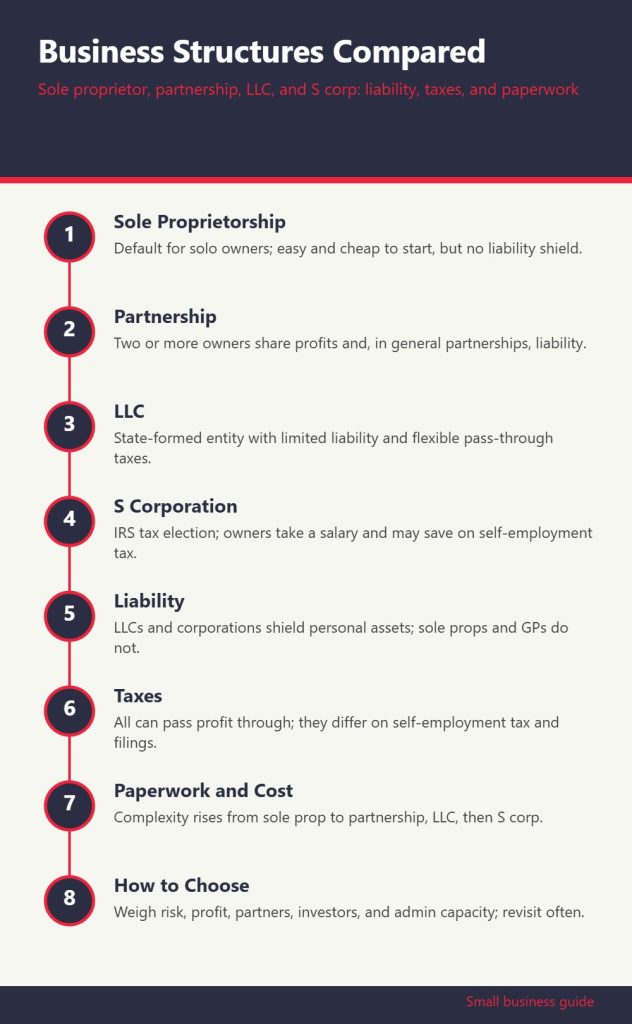
Sole Proprietorship: The Default for Solo Owners
If you start doing business on your own without filing anything with your state, you are a sole proprietor by default. There is no separate legal entity. You and the business are the same person in the eyes of the law and the IRS.
How it works: Business income and expenses are reported on your personal tax return, typically on Schedule C in the United States. You pay income tax on the profit and generally self-employment tax as well. You may still need local licenses, and if you operate under a name other than your own, many states require a “doing business as” (DBA) registration.
Best for: Freelancers, consultants, and side businesses with low liability risk who want to start quickly and cheaply, often to test an idea before committing to a formal entity.
The catch: There is no liability shield. If the business is sued or cannot pay its debts, your personal assets, such as savings, car, and potentially home, can be at risk depending on your state’s protections. Insurance helps, but it does not replace the separation an entity can provide.
Partnership: Two or More Owners, Shared Everything
When two or more people go into business together without forming another entity, they usually create a general partnership automatically. Like a sole proprietorship, it is simple to start, but it comes with shared exposure.
How it works: The partnership files an informational tax return, and each partner receives a statement of their share of income or loss, which they report on their personal returns. The partnership itself generally does not pay income tax; profits “pass through” to the partners.
Variations: Many states also allow limited partnerships, where some partners invest without managing and have limited liability, and limited liability partnerships, often used by professional firms, which shield partners from certain liabilities created by the others.
The catch: In a general partnership, each partner can be personally liable for business debts, including obligations created by the other partner. A written partnership agreement covering ownership percentages, decision-making, contributions, and what happens if someone leaves is essential, yet many partners skip it until a dispute arises.
LLC: Liability Protection With Flexible Taxes
The limited liability company has become a popular choice for small businesses because it combines liability protection with relatively light administration. An LLC is created under state law by filing formation documents, often called articles of organization, with the state.
How it works: By default for federal taxes, a single-member LLC is treated like a sole proprietorship (a “disregarded entity”), and a multi-member LLC is treated like a partnership. That means profits pass through to the owners’ personal returns. An LLC can also elect to be taxed as an S corporation or a C corporation if that is more advantageous.
Best for: Owners who want to separate personal assets from business liabilities without the formalities of a corporation, including many service providers, landlords, retailers, and small product companies.
The catch: Liability protection is not absolute. Courts can disregard the LLC, sometimes called piercing the veil, if owners mix personal and business funds, fail to keep basic records, or use the company to commit fraud. States also charge formation fees and, in many cases, annual report fees or franchise taxes, which vary widely. If you are leaning toward an LLC and want to understand the filing process in plain terms, GrowBizLab has a practical walkthrough of forming one; go here to read the step-by-step version before you file with your state.
S Corporation: A Tax Election, Not a Separate Entity Type
This is where much of the confusion lives. An S corporation is not formed the way an LLC is. It is a federal tax status that an eligible corporation, or an LLC that elects corporate tax treatment, chooses by filing an election with the IRS (Form 2553).
How it works: Like a partnership, an S corporation generally passes income through to its owners, who report it on their personal returns. The key difference is how owners who work in the business get paid. They must take a reasonable salary through payroll, which is subject to payroll taxes. Remaining profits can be distributed to owners, and those distributions are generally not subject to self-employment tax. For profitable businesses, that can produce meaningful savings.
Eligibility rules: S corporations face restrictions, including a limit on the number of shareholders, generally allowing only one class of stock, and requiring shareholders to be individuals who are U.S. citizens or residents, along with certain trusts and estates. Most businesses with outside investors such as venture funds cannot qualify.
The catch: Running payroll, filing a separate corporate tax return, and setting a defensible salary all add cost and complexity. The IRS scrutinizes salaries that look artificially low. For businesses with modest profits, the savings may not outweigh the extra accounting fees, which is why many owners start as an LLC and elect S corporation status only once profits grow.
Liability Compared
When it comes to protecting personal assets, the four options fall into two groups:
- No built-in protection: sole proprietorships and general partnerships. Owners are personally responsible for business debts and legal judgments.
- Limited liability: LLCs and corporations, including those taxed as S corporations. Owners are generally shielded from business debts beyond what they invested, as long as they respect the separation between personal and business affairs.
Two caveats apply to everyone. First, no structure protects you from your own professional negligence or wrongdoing. Second, lenders and landlords commonly ask small business owners to sign personal guarantees, which put your personal assets back on the line for that specific obligation regardless of structure.
Taxes Compared
All four structures can be pass-through arrangements, meaning profits are taxed on the owners’ personal returns rather than at the business level. The differences show up in self-employment tax and filing requirements:
- Sole proprietors and single-member LLCs: Report profit on personal returns and generally pay self-employment tax on net earnings.
- Partnerships and multi-member LLCs: File a partnership return; partners report their shares and active partners generally pay self-employment tax on their portion.
- S corporations: File a corporate return; owner-employees pay payroll taxes on salary, while distributions are generally free of self-employment tax.
State taxes add another layer. Some states impose franchise taxes, gross receipts taxes, or minimum annual fees on LLCs and corporations, and a few treat S corporations differently from the federal rules. This is a big reason to get local advice before choosing.
Paperwork and Cost Compared
Roughly in order from simplest to most involved:
- Sole proprietorship: Minimal setup, perhaps a DBA and local licenses. Taxes filed with your personal return.
- General partnership: Minimal state filing, but you should draft a partnership agreement and file a separate informational return.
- LLC: State formation filing, an operating agreement (recommended even when not required), and annual reports or fees in many states.
- S corporation: Everything required for the underlying LLC or corporation, plus the IRS election, payroll for owner-employees, a corporate tax return, and in the case of a corporation, formalities such as bylaws and meeting minutes.
How to Choose the Right Structure
Rather than looking for the “best” structure, ask which one fits your current situation. A few guiding questions:
- How much liability risk does your work carry? Physical premises, employees, client advice, and products that could cause harm all argue for an entity with limited liability.
- How profitable are you, or soon will you be? S corporation tax treatment tends to make more sense as profits rise well beyond what a reasonable salary would be.
- Do you have partners? If so, an LLC with a clear operating agreement often beats an informal partnership.
- Will you raise outside investment? Investors such as venture funds typically expect a C corporation, which is outside the scope of this comparison but worth knowing about.
- How much administration can you handle? Be realistic about bookkeeping, payroll, and annual filings.
Remember that the choice is not permanent. Many businesses start as sole proprietorships, form an LLC once revenue or risk grows, and later elect S corporation taxation when profits justify it. GrowBizLab covers each of these transitions in its business setup section, so you can learn more about the timing and paperwork involved when your business outgrows its first structure.
Mistakes to Avoid
- Forming an entity and then mixing funds. Using the business account for personal expenses can undermine liability protection.
- Electing S corporation status too early. If profits are low, payroll and accounting costs can exceed the tax savings.
- Skipping the operating or partnership agreement. Disagreements between owners are far easier to resolve when the rules were written down in advance.
- Forgetting state-level costs. Annual fees and franchise taxes differ widely and can change the math.
- Choosing based on what a friend did. Their industry, income, and state may be nothing like yours.
The right structure is the one that protects you adequately, keeps taxes reasonable, and creates paperwork you can actually maintain. Start with an honest look at your risk and profit, get a professional opinion for your state, and revisit the decision as your business grows.