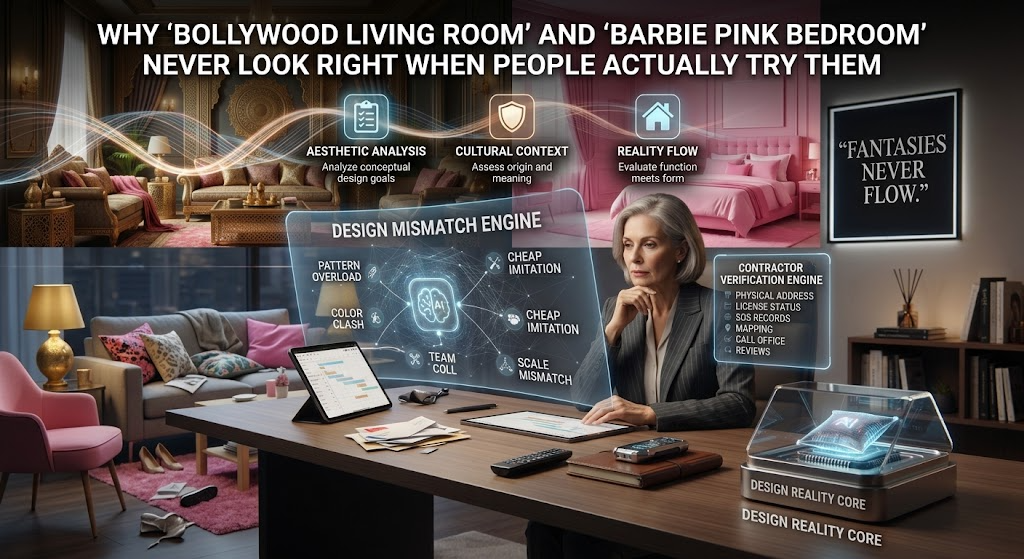
Something a lot of moviegoers do without realizing it: they save a screenshot of a room they love from a film, then quietly try to rebuild pieces of it at home. The blush-pink bedroom from Barbie. The high-ceilinged Bollywood family living room with the marble floor and the arched doorway. The tight, moody office from an Indian thriller series. The oak-panelled study from Knives Out. The candy-striped hallway from Wes Anderson’s last picture.
Then the paint dries, the furniture arrives, and something is wrong. The colors are close. The proportions are close. The room reads as “a version of that movie room,” but not the version that made you screenshot it. This happens to a lot of people, and the reason it happens is almost never bad taste.
Movie interiors are engineered to be looked at through one specific camera lens, under one specific lighting rig, and framed against a wall that may or may not exist ten feet away. Home rooms are lived in from every angle, lit by whatever sun and lamps you happen to have, and framed by neighbors your set designer did not pick. Those two things are close cousins, not the same job.
What a Movie Room Actually Is
A film set is a decision about what the camera will see for six seconds, not what a family will live inside for six years. Ceilings are often removed entirely so the lighting crew can hang rigs above them. Walls are on rollers. Colors are chosen assuming a specific color grade will be applied in post, which shifts everything toward warmer or cooler than the paint chip suggests. The “brutal minimalism” of a Delhi high-rise apartment in a movie may be the same neutral palette as your bedroom — except the movie apartment is 14 feet tall, has no ceiling fan, and has a diffused softbox where your reading lamp lives.
None of this is a trick. It’s just that the room you love is a room-plus-camera-plus-lighting-plus-post, and you have been trying to buy only the first part of that stack.
That’s the gap a small workaround has quietly closed over the last year. Before repainting or ordering furniture, more homeowners are photographing their actual room, uploading it to a tool like RoomDesignGPT, and asking it to render the movie direction they liked — Bollywood-luxe, Barbie-pastel, Wes-Anderson-symmetric, brutal-minimal — on their real walls, real ceiling height, real window light. It doesn’t replace the aesthetic instinct that made you screenshot the room in the first place. It shows you whether that instinct is going to survive contact with your specific apartment.
The Three Things That Trip Real Rooms
There are three specific reasons the copy of a movie room usually feels off in a home, and it helps to name them.
Scale. Iconic movie rooms are frequently oversized. A high ceiling makes a small piece of furniture look like a sculpture. Drop that same piece into a standard 8-foot ceiling and it becomes a large piece of furniture that dominates the room. The scale ratio you’re actually copying is the ratio of chair to ceiling, not the chair itself.
Light temperature. A Bollywood family living room lit for a wedding scene is glowing at roughly 2700K with a lot of bounce. Your living room after sunset, lit by cool overhead LEDs, may be at 5000K with almost no bounce. The same yellow curtain looks warm gold in one and muddy mustard in the other.
Layering density. Movie rooms are typically overdressed. Set decorators add three to five times the number of small objects a real room would carry, because the camera reads a cluttered scene as “lived in.” Try to add that same density to your actual living room and it reads as “cluttered.” The finished movie shot is closer to a museum diorama than to a home.
None of these problems are fixable with better shopping. They’re fixable with a preview.
How the Preview Actually Helps
Once you have a rendered version of the aesthetic in your own room, the decisions get cheaper. You see immediately whether the wall color you fell in love with reads warm or muddy under your existing light. You see whether the tall arched mirror from the movie shrinks the ceiling instead of stretching it. You see whether the “richly layered” Bollywood living room reads as decorated or as cluttered at your ceiling height.
The point isn’t that the tool designs your room. The point is that it removes the guesswork. You get to see the screenshot version and the your-room version side by side before spending money. Sometimes the answer is that the aesthetic still works and you should keep going. Sometimes the answer is that your ceiling is too low or your window light is too cool for the specific look you loved on screen — which is not a small thing to learn before ordering the sofa.
Kitchens Are Where Movie Copies Fail Hardest
Some rooms carry more of a movie’s mood than others, and the kitchen usually carries the most. The copper pots and open shelving in Julie & Julia. The crowded, warmly-lit Bollywood family kitchen where three generations argue over dinner. The industrial steel and back-of-house lighting of The Bear. Every one of them reads as “the heart of the film” and every one of them gets copied more than the living rooms of the same movies.
Kitchens are also where the copy-a-movie problem gets loudest, because the layout is fixed by the appliances and the light is fixed by the window and the hob. You cannot move a stove for aesthetic reasons. You cannot repaint your way out of a north-facing kitchen if the movie was shot in a south-facing one. Running an ai kitchen design preview against your actual kitchen photo shows you which movie kitchen aesthetic your room can carry and which one will fight your window and your existing cabinetry. It is usually the check that saves the most money, because kitchens are the most expensive room to get wrong.
What This Actually Changes
The habit that’s forming among homeowners in 2026 is not “copy a movie room.” It’s “test a movie aesthetic against your own room before committing.” That shift matters because a repaint costs a weekend and a few thousand rupees to fix. A wrong-scale sofa costs a lot more, and a wrong-scale kitchen renovation costs a lot more than that. The couple of minutes it takes to upload a photo and see the direction rendered against your actual space is, for most people, the cheapest form of insurance a room decision can carry.
Movie rooms are still worth chasing. They just work better as prompts than as blueprints. The screenshot you saved is a starting point for a conversation between the aesthetic you love and the room you actually own, and that conversation is a lot easier to have when you can see both sides at once.