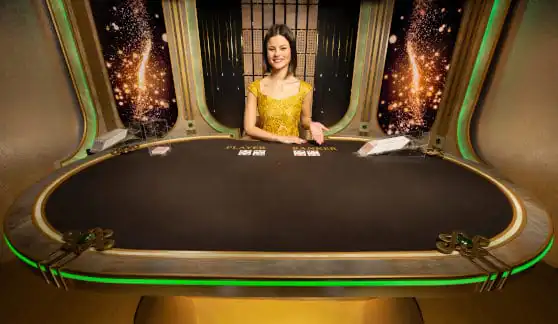
Peek Baccarat takes standard live baccarat and adds a twist: you can briefly see one to four cards before deciding whether to increase your wager. The rules and payouts mostly mirror classic baccarat, but a mandatory fee on qualifying bets and a powerful psychological illusion—that more information must mean better decisions—combine to change both expected value and in-game behaviour in ways many players underestimate.
What Peek Baccarat Changes Compared to Standard Baccarat
Peek Baccarat is built on eight-deck punto banco, where bets go on Player, Banker, or Tie and the hand closest to nine wins, with Player paying 1:1 and Banker usually paying 0.95:1. The key change is that when you bet on Player or Banker, the game charges a fixed 20% “peek fee” on that initial stake in exchange for the option to see up to four cards before deciding whether to raise your bet.
Mechanically, this means the core drawing rules and win conditions remain untouched, but the economic structure around each main bet is modified. Every qualifying wager now carries an automatic surcharge, so the base bet becomes more expensive in expectation even though headline payouts look unchanged, and the value of the peek depends entirely on how consistently a player uses that extra information to scale up or hold back.
How the Peek Mechanism Actually Works
In a typical round of Peek Baccarat, players first place their bets on Player, Banker, or Tie; the 20% fee applies only to Player and Banker wagers, not to Tie or many side bets. After the initial two cards are dealt to each side, the dealer reveals between one and four cards—often edges or full faces—giving players a snapshot of the developing hand before the third-card rules are resolved.
During the brief decision window that follows, the betting grid expands, allowing the player to keep the original stake, double it, or triple it on the same side, with no extra fee beyond the initial 20% already paid. Once that window closes, the remaining cards are dealt out under standard rules; the hand closest to nine wins, with ordinary payouts applied, and in the case of a tie, Player and Banker bets are typically returned minus the non-refundable peek fee.
Why the 20% Peek Fee Matters More Than the Peek
At first glance, the ability to react to partially revealed cards seems to grant an edge, especially if the revealed information shows a strong position for the side you backed. However, the economics of the peek fee work in the opposite direction: a 20% charge applied to every qualifying main bet quietly drags down long-term return unless the advantage gained from selectively increasing stakes is consistently large.
Analyses of Peek Baccarat report a theoretical return for the main hand around 98.8% when using the feature properly, which is competitive with standard baccarat but contingent on behaviour. If a player frequently pays the fee and then rarely doubles or triples when the peek is favourable, the fee behaves as a recurring tax on otherwise ordinary bets, and the gap between perceived and actual advantage widens. In effect, the peek only adds value if the player is both disciplined and accurate enough to scale stakes in line with genuinely improved probabilities, not just heightened confidence.
The Psychological Layer: Why Seeing Cards Feels Like Power
The main appeal of Peek Baccarat is psychological. Being able to see up to four cards mid-hand triggers a strong sense of control and insider knowledge, similar to the way traditional squeeze rituals make players feel more involved even though the underlying odds do not change. That feeling of privileged vision makes it easier to believe that doubling or tripling a bet is justified, because the decision feels informed rather than speculative.
In practice, this can lead to overconfidence. Players may overestimate their ability to infer final totals from partial information, especially when only some cards are visible or when the third-card rules can still shift the outcome. The impact is that the peek feature nudges decisions away from flat, consistent staking and toward reactive bet sizing driven by emotional responses to what has just been seen, increasing volatility and potentially magnifying loss streaks despite the game’s high headline RTP.
Conditional Scenarios: When Peeking Helps or Hurts
Peek decisions unfold in a few recurring patterns that determine whether the feature improves or harms expected results.
- When the revealed cards clearly favour your chosen side—for example, a strong two-card total while the other side shows a weak start—raising the stake can improve average outcomes because more capital is exposed in relatively better situations.
- When the peek shows an ambiguous or marginal situation, but the player still increases the bet due to frustration or “chasing,” the fee plus the extra stake combine to make neutral spots more expensive than in standard baccarat.
- When the peek reveals a poor setup, disciplined players who resist increasing and perhaps lower future stakes can partially offset the cost of the fee, while undisciplined players who double anyway turn the feature into a consistent drag on their bankroll.
Interpreting these scenarios shows that peeking does not inherently favour the house or the player; the 20% fee leans toward the casino by default, and only a consistently selective response to favourable reveals can reclaim some of that built-in disadvantage.
Live Game / In-Play Reading: How Peek Changes the Tempo of Decisions
From a live-game perspective, Peek Baccarat is slower and more segmented than standard fast-deal baccarat. Each hand has a natural pause after the initial deal while the peek occurs, cards are partially exposed, and the extra betting grid opens, creating a rhythm of reveal–evaluate–adjust that extends decision time beyond a simple pre-deal choice. That pause increases cognitive load but also invites more in-play micromanagement of stake levels than ordinary baccarat does.
Over a session, this structure encourages players to treat every hand as a small tactical puzzle, rather than as one spin of a fixed-odds wheel. The impact is twofold: engaged players may feel more in control and more able to “correct” previous mistakes by reacting mid-hand, while the same dynamic can make it harder to maintain pre-set limits because each peek feels like an opportunity to repair or amplify outcomes on the fly.
How UFABET Ecosystems Shape Peek Baccarat Behaviour
In a multi-game environment where numerous baccarat variants coexist, the way Peek Baccarat is presented in the lobby and at the table influences how it fits into a player’s overall habits. Many users browse by visual thumbnails, advertised features, and perceived excitement rather than by comparing rule sheets or edge statistics, especially when moving between titles during a single bankroll session. Within that context, UFABET operates as a platform where Peek Baccarat sits alongside standard, squeeze, and side-bet-heavy versions, and the ability to peek and then expand the wager grid mid-hand can feel like a natural bridge for players who already enjoy card-squeeze theatrics, leading them to accept the 20% fee as part of the experience rather than as a negotiable cost that should be weighed against flatter, less interactive options in the same catalogue.
Where the “More Information” Concept Strengthens or Weakens Your Edge
Conceptually, Peek Baccarat is built on an intuitively appealing idea: more information should allow better decisions. When treated as a disciplined tool, peeking can indeed strengthen a strategy by letting players increase stakes only when the revealed cards materially improve the chances of a win, and by discouraging aggressive betting when the early cards are unfavourable. In that narrow frame, the feature helps align stake size with conditional probability instead of pure pre-hand guesswork.
Yet several factors weaken this theoretical edge. The mandatory fee is charged whether or not the player ever increases their bet, so casual or infrequent use of the doubling/tripling options simply adds cost without proportionate benefit. Furthermore, many players struggle to interpret partial reveals accurately, especially under time pressure, which can turn the peek into a trigger for emotionally driven bets that are misaligned with the actual odds of the final totals.
How casino online Interfaces Amplify the Psychological Pull of Peeking
In remote-play settings, Peek Baccarat’s design is tightly integrated with interface elements that spotlight the peek moment. High-definition close-ups of the cards, slow reveals, and expanding betting grids all converge on a single decision interval that feels more consequential than a standard “bet before deal” step, even though the underlying probabilities are fixed by the card distribution and third-card rules. As the animation and layout highlight this interval, players experience a strong sense that they are seizing or squandering opportunities depending on how aggressively they respond to each peek.
When a casino online presents Peek Baccarat alongside more conventional tables, the game’s mid-hand interactivity and theatrical peeks can make ordinary variants seem flat, nudging frequent live players toward a format where each round carries an added fee and an extra urge to up the stakes. Over time, that shift in preference raises the average cost per hand across a session, as more wagers are filtered through a fee-bearing structure that relies on precise, consistent decision-making to avoid turning the psychological thrill into a quiet but steady leak.
Summary
Peek Baccarat layers a card-reveal mechanic and mid-hand bet adjustment onto standard live baccarat, combining a mandatory 20% fee on Player and Banker bets with the option to double or triple stakes after seeing up to four cards. The core rules and base payouts remain familiar, but the economics change: the fee tilts expectation toward the house by default, and only disciplined, selective use of the peek to scale stakes in genuinely favourable situations can reclaim some of that cost. Psychologically, the sense of insight created by peeking often outweighs sober probability in the moment, so anyone drawn to this format needs to recognise that the extra information is valuable only if it consistently guides measured, not impulsive, decisions in a game whose underlying math still favours the house across many hands.