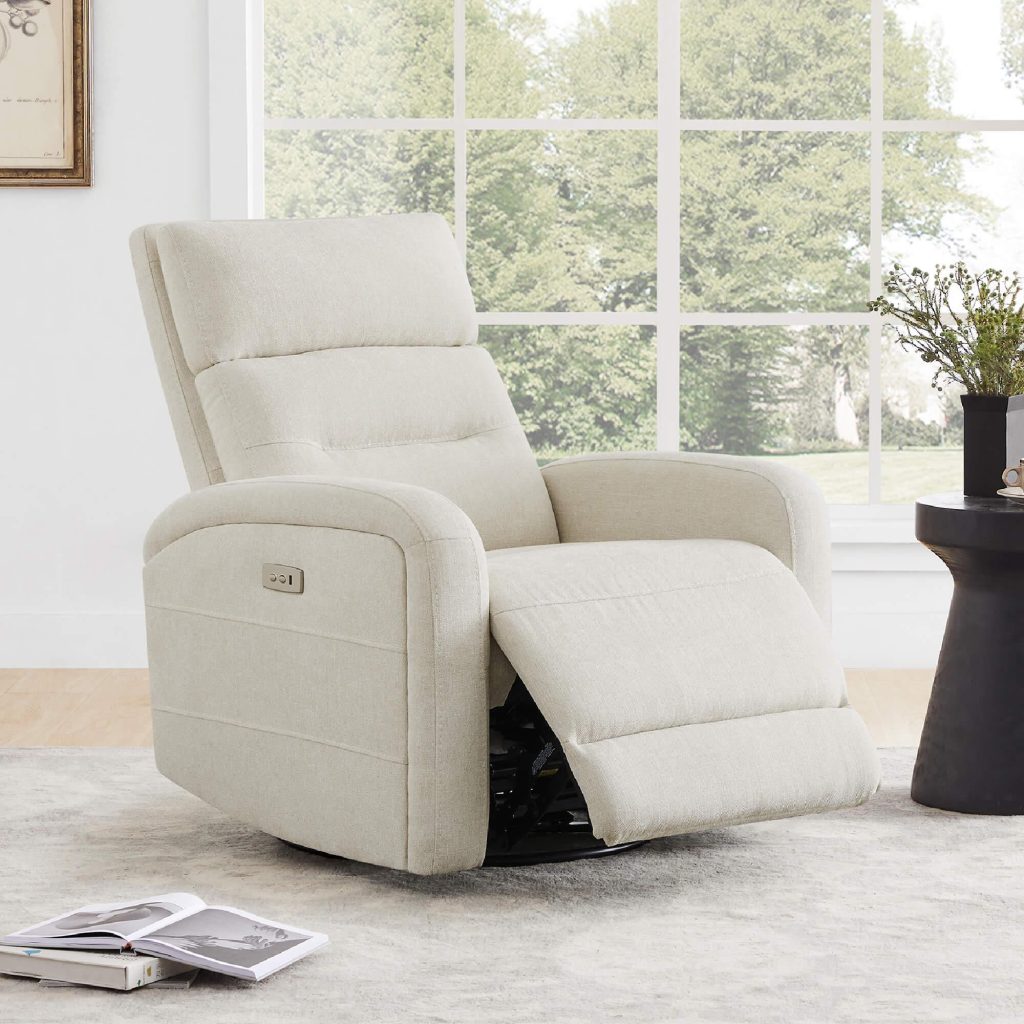
Watch how people actually sit in a living room and you will notice something the furniture rarely allows: they turn. They pivot toward whoever is talking, twist to reach a side table, rotate to see the screen when the sun shifts, and swing back to the window when a bird lands outside. Fixed seating ignores all of that and asks the body to do the work instead.
A swivel recliner removes the effort. The seat turns, the back reclines, and the footrest lifts, all from a single position. What sounds like a modest convenience turns out to be the reason the chair becomes the one everyone wants — it works for reading, for conversation, for dozing, and for watching without being dragged around the room.
This piece looks at where that flexibility comes from, how the mechanism should feel in practice, and how to place one so it improves a room instead of simply occupying it.
Why Rotation Changes How a Room Works
Most living rooms have more than one focal point. There is a television, certainly, but also a fireplace, a window, a chair where a partner sits, and the path to the kitchen. A fixed chair has to pick one. A swivel recliner can face any of them without moving its base, so the room no longer has to be arranged around one direction.
That flexibility is especially valuable in open-plan homes, where the seating area is visible from the kitchen and also serves as the spot for a conversation. Sitting at an angle rather than square-on to the television is more comfortable for talking, and the ability to turn toward the room keeps the chair from becoming a solitary viewing post. In a small space, the pivot often replaces a second chair because one seat now handles two orientations.
Shared Spaces, Shared Comfort
Swivel seating is also unusually fair in a shared room. A guest can turn to join the conversation; the person reading can angle toward the lamp; the person dozing can face away from the glare. No one has to claim the best chair, because the chair adapts. In households where the seating is limited, that versatility does more than an extra ottoman ever will.
There is a practical benefit that only shows up after a few months: the chair stays where you put it. Fixed recliners get dragged across the floor as people chase the best angle, which marks wood floors and slowly wears the base. A swivel base removes the reason to move it at all, so the seat holds its position and the rug underneath stays flat.
How the Mechanism Should Feel
The quality of a recliner is mostly hidden in the mechanism, and the way it behaves tells you a great deal before any fabric is considered. Sit down and test the full cycle: rotate a quarter turn both ways, recline to the deepest position, raise the footrest, then close everything. The motion should be smooth and quiet, with no catching or sudden drop at the end of travel.
Swivel and Glide
The swivel base does two jobs. It allows rotation, and it keeps the footprint compact because the chair turns on a column instead of sweeping an arc across the floor. On glider models, the same seat also rocks forward and back, which is why these chairs are popular in nurseries and in rooms where a gentle motion helps settle a baby or a restless reader. Check that the glide is even and that the seat does not wander off-center as it moves.
Power Versus Manual
Power recline is worth the upgrade if the chair will be used daily, and it is nearly essential for anyone with limited grip strength or mobility. A powered footrest closes slowly and quietly instead of snapping shut, and a powered headrest lets you tilt the neck independently of the back. Manual handles are simpler and never need an outlet, but they force you back into a small set of preset positions. If the chair includes heat or massage, treat those as bonuses rather than the deciding feature — the rotation, recline, and headrest are what you will notice every day.

Placing It Without Wrecking the Layout
The advantage of a swivel base is that it needs less clearance than a conventional recliner, because it does not have to travel backward to recline. Even so, the chair still needs room to rotate without clipping a side table, and the footrest still projects forward when raised. Set the chair at least a hand’s width from the wall behind it and confirm that a two-foot zone in front stays clear when the leg rest is up.
Angle is the other decision. Facing the room’s center rather than the television head-on usually reads better and encourages conversation, and the swivel means the screen is still reachable with a small turn. In a corner, a recliner set at roughly forty-five degrees anchors the space and leaves the widest possible walking path in front of it.
Power routing deserves the same planning. Trace the cord’s exit point before the chair arrives, decide whether it runs along the baseboard or under the rug, and place the outlet cover so the plug is not in the middle of a walkway. A short extension in a matching color is easier to live with than a cable pulled taut across a floor, and a cord channel keeps it tidy against the wall.
Clearing the Rotation Zone
Draw a circle on the floor with chalk or tape, centered on the base and roughly the width of the chair plus a hand’s length. Walk around that circle and note what it clips: a floor lamp, a magazine basket, the corner of a coffee table. Anything inside the rotation envelope will be bumped the first week, either by the chair or by you trying to avoid it. Move those objects out of the arc rather than repositioning the chair, because the chair’s placement was chosen for the room’s focal point while the small objects were mostly accidental. A side table at the edge of the circle is useful; one inside it is a hazard.
Keeping It Visually Light
Recliners have a history of looking heavy, and the bulk usually comes from thick arms and deep shoulders. Slimmer tracks, tapered legs, and a narrower back keep the chair from dominating a small room while preserving the seat depth that makes it comfortable. Mid-century frames handle this best because the legs lift the mass off the floor, so the chair reads as suspended rather than planted.
Color does similar work. A light leather or a warm neutral reduces apparent size, while a dark frame against pale walls can look larger than it is. If the room already has a strong sofa, choose a recliner that repeats one of its materials rather than introducing another. CHITA LIVING’s swivel and glider pieces keep frames restrained for exactly this reason, letting the chair blend with a room instead of competing with it.
Nursery and Reading Nook Uses
The glider version of the swivel recliner has become standard in nurseries, and for good reason. A seat that rocks and turns lets a parent settle a baby without getting up, and the swivel makes it easy to reach a crib or a shelf without disturbing a sleeping child. Outside the nursery, the same motion suits a reading nook: a lamp at the shoulder, a small table within a quarter turn, and enough recline for a long chapter.
If the chair will live near a window, watch the sun. Direct light fades leather and heats the surface even through glass, so a sheer curtain or a slightly rotated placement protects both the material and the sitter. Add a floor lamp behind the shoulder rather than overhead, and keep a small tray table at arm height so a cup never has to balance on a cushion.

One Seat, Many Directions
A swivel recliner earns its place by letting the sitter decide where to look rather than the room deciding for them. Test the mechanism in person if you can, favor smooth rotation and a slow-closing footrest over extra gadgets, and place the chair at an angle so it joins the conversation instead of interrupting it.
Choose a frame light enough to suit the room and a material that can handle daily use, and the chair will quietly become the most-used seat in the house — turning toward whatever the day asks of it.